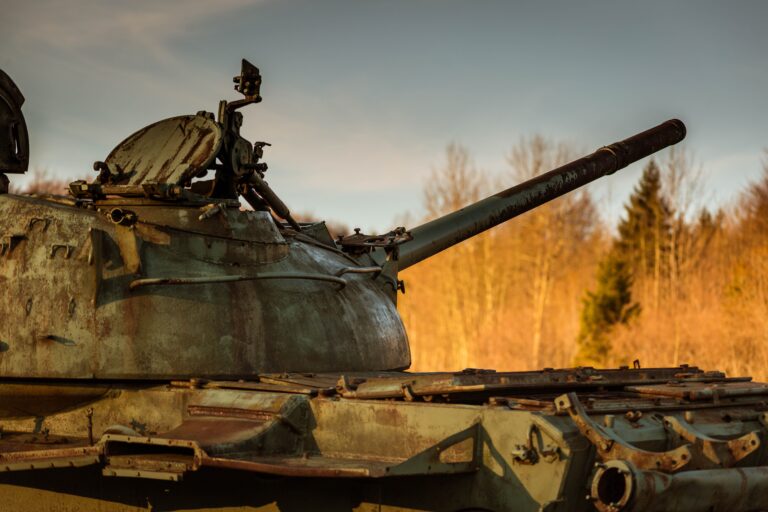

From the Geopolitics of Territory to the Geopolitics of Technology, Information and Influence
By Dr. Sadri RAMABAJA
Albanian Institute for Geopolitics, Pristina, Republic of Kosova
The Albanian Institute for Geopolitics is a partner of the Political Science Institute. This article is published with permission.
Abstract
This study examines the transformation of the strategic environment of the Western Balkans under the impact of the technological revolution, particularly unmanned systems, artificial intelligence, electronic warfare, cyber capabilities, and real-time information processing. At the center of the analysis is Serbia as a regional actor with considerable military, political, and influence ambitions, while Kosova is approached as a node within the Euro-Atlantic security architecture rather than merely as an object of territorial conflict.
The study argues that technology does not replace traditional military power, but changes the way such power is generated, integrated, and employed. At the same time, the “Serbian World” is analyzed as a multidimensional architecture of influence that combines political, diplomatic, economic, cultural, identity-based, and informational instruments. The study does not treat the “Serbian World” as a codified state doctrine; rather, it conceptualizes it as a strategic narrative and a framework for projecting regional influence.
The central conclusion is that under the new conditions of strategic competition, superiority is determined not merely by the number of military platforms, but by the ability to integrate technology, information, human capital, industry, institutions, diplomacy, and alliances. For Albania and Kosova, this implies a shift from being “security consumers” to becoming producers of strategic capabilities.
Keywords: geopolitics, Western Balkans, Serbia, “Serbian World,” Kosova, Albania, drones, artificial intelligence, hybrid warfare, deterrence, NATO, technological security.
1. Introduction: From the Technological Revolution to the Reconfiguration of Strategic Balances in the Balkans
The twenty-first century is fundamentally changing the way states conceptualize power, security, and geopolitical competition. While for most of the twentieth century strategic superiority was measured primarily by the size of armies, industrial capacity, and arsenals of heavy platforms, contemporary conflicts demonstrate that this model is no longer sufficient. Technology, information, data-processing speed, artificial intelligence, unmanned systems, electronic warfare, and cybersecurity are becoming increasingly decisive components of state power.
The Russia–Ukraine war has made this transformation particularly visible. It has demonstrated that quantitative superiority in weaponry does not necessarily guarantee strategic superiority if it is not accompanied by the ability to produce, integrate, and adapt technology at a very high pace. Drones have thus evolved from an auxiliary tactical tool into a component of a new warfare ecosystem, in which sensors, communications, data, algorithms, and operational effects are integrated into a single cycle.
This transformation is of particular importance for the Western Balkans. The region remains a space where the boundaries between political competition, informational influence, economic pressure, and military threat are becoming increasingly blurred. For this reason, the technological revolution should not be viewed merely as a transformation of military arsenals, but as a transformation of the very way in which states build power, exercise influence, and calculate risk.
In this context, Serbia represents a particularly important case study. Its military modernization and efforts to combine traditional capabilities with emerging technologies should be analyzed not only in terms of its military power, but also in relation to the broader objectives of its regional policy. The question is not simply how many weapons Serbia possesses, but what kind of power it is seeking to build and how this relates to the projection of influence across the former Yugoslav space.
It is precisely here that the technological revolution, the Kosova question, and the geopolitical concept of the “Serbian World” intersect. Kosova is no longer merely the object of a territorial claim. It is part of an international security architecture in which the presence of NATO and KFOR, the institutional development of the Republic, and its links with Euro-Atlantic structures significantly alter Belgrade’s calculations regarding any potential course of action.
At the same time, the “Serbian World” should not be understood solely through a territorial dimension. Under contemporary conditions, influence can be projected through diplomacy, economics, culture, media, institutional networks, and informational instruments. This shifts the analysis from the traditional question of territorial control toward the more complex question of control over the space of influence.
This is precisely where the analysis acquires its strategic dimension. If technology is lowering the cost of certain forms of attack and increasing the speed at which information spreads, it is simultaneously increasing the importance of intelligence, prevention, cyber defense, and rapid-response capabilities. The technological revolution therefore does not eliminate the risk of conflict; it changes its structure and, along with it, the cost–benefit calculus of strategic adventurism.
This raises the central question of the present analysis:
Is the revolution in drones and emerging technologies changing only the way warfare is conducted, or is it also transforming the geopolitical balance in the Balkans and, in particular, Serbia’s strategic calculus toward Kosova?
Answering this question requires examination at several levels: first, the transformation of the nature of warfare; second, the limits of Serbian military modernization; third, Kosova as a new node of regional security; fourth, the “Serbian World” as a project of multidimensional influence; and finally, the need for Albania and Kosova to move from a paradigm of security consumption toward one of producing strategic capabilities.
This transition is particularly important under conditions in which security cannot rely solely on the acquisition of weapons, but requires knowledge, industry, technology, diplomacy, and institutions capable of operating as an integrated ecosystem.
Therefore, the fundamental thesis of this analysis is that the new strategic competition in the Balkans will not be determined solely by the quantity of weapons, but by states’ ability to integrate technology, knowledge, organization, and alliances into a coherent system of power. In this sense, the drone revolution is merely the most visible sign of a much deeper transformation: the transition from the geopolitics of platforms to the geopolitics of information, innovation, and technology.
2. Research Problem and Central Question
The twenty-first century is bringing about a significant transformation in the way state power is generated. Instead of a model in which power was primarily associated with territory, population, heavy industry, and conventional arsenals, a more complex structure is emerging in which information, the speed of decision-making, artificial intelligence, unmanned systems, cybersecurity, space, and the ability to produce and integrate technology are becoming increasingly important.
The war in Ukraine has made this transformation particularly visible. SIPRI notes that in the conflicts of 2025, UAVs were used for long-range strikes, saturation attacks against air defenses, FPV operations, and coordinated operations against strategic targets. This demonstrates that the UAV is no longer merely a supporting tool, but has become part of new architectures of warfare.
Therefore, the central question of this study is:
Is the technological revolution changing only the way warfare is conducted, or is it also transforming the strategic balance in the Balkans and, in particular, Serbia’s calculus toward Kosova?
This question is divided into five sub-questions:
- How is technology changing the nature of military power?
- What does Serbia’s military modernization reveal about its ambitions and capabilities?
- How do the presence of KFOR and the Euro-Atlantic security architecture affect Serbia’s strategic calculus?
- Can the “Serbian World” be conceptualized as a multidimensional ecosystem of influence?
- What capabilities must Albania and Kosova develop in order to become producers of security?
3. Theoretical Framework
The study draws upon an interplay of four theoretical approaches.
I. Realism and the Distribution of Power
From a realist perspective, states operate within an anarchic international system and seek to increase their security and power. Mearsheimer places material power and the relative position of states at the center of the analysis of international competition.
However, this study argues that material power should not be measured solely by the number of weapons. In the technological age, what also matters is the quality of the system that connects these weapons with information, sensors, communications, and decision-making.
II. Power as the Integration of Capabilities
The concept of power needs to be expanded from platform power to ecosystem power.
This can be formalized as follows:
Strategic power = platforms + information + technology + human capital + industry + institutions + alliances.
Thus, a state with fewer platforms may generate a greater strategic effect if it possesses superior capabilities to integrate them.
III. Soft Power and Sharp Power
Nye conceptualizes soft power as the ability to influence others through attraction rather than solely through coercion. In the Balkan context, this dimension should be complemented by the concept of sharp power: the use of information, media, political networks, and other instruments to distort perceptions or create dependencies.
This is particularly important for the analysis of the “Serbian World.”
IV. Regional Security Complex
In the framework developed by Buzan and Wæver, security threats tend to cluster into regional security complexes. The Western Balkans constitute such a case: the security of Kosova, Serbia, Bosnia and Herzegovina, Montenegro, and North Macedonia cannot be fully analyzed in isolation.
Therefore, a crisis in Kosova should be analyzed as a potential shock to the regional security complex.
4. Methodology
This study employs a combined methodology:
a) Theoretical analysis – to conceptualize power, deterrence, technology, and influence.
b) Empirical analysis – based on data concerning military expenditure, arms modernization, technological capabilities, and developments in regional security.
c) Documentary analysis – drawing upon documents from NATO, the EU, SIPRI, and other relevant institutions.
d) Comparative analysis – Serbia is compared with the capabilities of Kosova and Albania, as well as with the constraints arising from the Euro-Atlantic security architecture.
e) Process tracing – to trace the causal relationship between:
modernization → capability → threat perception → deterrence → strategic calculus.
f) Case study – Serbia/Kosova are treated as a case study of the relationship between technology, power, and regional influence.
5. Hypotheses
H1 – The Technological Hypothesis
The greater a state’s capacity to integrate sensors, data, AI, unmanned systems, communications, and operational effects, the greater its strategic power beyond the size of its traditional arsenals.
This hypothesis is supported by developments in Ukraine and by SIPRI’s analysis of the use of UAVs in recent conflicts.
H2 – The Serbian Modernization Hypothesis
Military modernization increases Serbia’s capacity for deterrence and coercion, but does not automatically translate this capability into an ability to alter the status quo in Kosova.
This is due to the intervention of other factors, including KFOR, NATO, economic costs, regional interdependence, and diplomatic consequences.
H3 – The “Serbian World” Hypothesis
The “Serbian World” functions more effectively as an architecture of political, identity-based, cultural, and informational influence than as a direct territorial project.
This hypothesis is consistent with the study by Horák and Čermák, which describes the “Serbian World” as a strategic narrative rather than a codified state doctrine.
H4 – The Force-Constraint Hypothesis
The more deeply Kosova is integrated into the Euro-Atlantic security architecture, the higher the expected cost of the use of force by Serbia.
KFOR continues to operate under the mandate of UN Security Council Resolution 1244 and, even following the gradual adjustment of its presence in 2026, NATO retains its mission of maintaining security and freedom of movement in Kosova.
H5 – The Strategic Ecosystem Hypothesis
Small states can compensate for part of their material disadvantage if they succeed in building an integrated ecosystem of knowledge, technology, institutions, industry, and alliances.
This constitutes the study’s normative-strategic hypothesis and provides the foundation for proposing a new Albanian security doctrine.
6. Operationalization of the Hypotheses
In order not to remain at the declarative level, the hypotheses need to be measured through specific indicators.
| Variable | Indicators |
| Technological power | UAVs, AI, sensors, EW, cyber, C4ISR |
| Military power | Expenditure, personnel, platforms, munitions |
| Technological integration | Interoperability, software, data, command and control |
| Influence power | Media, diplomacy, economy, cultural networks |
| Deterrence | Allied presence, response capability, cost of aggression |
| Resilience | Cybersecurity, energy, communications, institutions |
| Human capital | Universities, R&D, experts, start-ups |
| Strategic autonomy | Domestic capabilities for maintenance, production, and innovation |
7. The Drone Revolution and the Transformation of the Nature of Warfare
7.1 From Industrial Superiority to Technological Superiority
For most of the twentieth century, military power was a function of industrial capacity. States that produced more steel, tanks, aircraft, and ships possessed a strategic advantage.
However, contemporary wars are demonstrating that an expensive platform can be neutralized by a much cheaper system. This has created a fundamental shift: from the logic of weapons accumulation to the logic of capability innovation.
In this sense, the drone is not simply a new weapon. It is a symbol of a new paradigm in which information, speed, and adaptability have become sources of power.
In modern warfare, the UAV is connected through a chain:
sensor → communication → data → algorithm → decision-making → operational effect.
This means that the value of the drone does not lie solely in the physical platform. What determines its effectiveness is the system into which the platform is integrated.
SIPRI observes that armed UAVs are being employed in an increasingly diverse range of roles, including long-range strikes, saturation attacks, FPV operations, and coordinated operations.
Therefore, the drone revolution is not a revolution in a single weapon; it is a revolution in the cycle of information and military decision-making.
8. Serbia and the Dilemma of Military Power in the New Era
8.1 Serbian Military Modernization and Its Strategic Limits
In recent years, Serbia has invested in the modernization of its armed forces, seeking to enhance its air, missile, and ground-defense capabilities.
However, the technological revolution in warfare raises a deeper question:
Is possessing modern weapons sufficient to create strategic superiority?
The answer provided by recent wars is negative.
Modern military power requires a combination of:
- real-time intelligence;
- electronic warfare capabilities;
- counter-drone defenses;
- cybersecurity;
- a domestic innovation industry;
- the ability to integrate technology into doctrine.
This is also where the limitations of any project based solely on the acquisition of weapons become apparent.
9. Kosova as a Factor in the New Serbian Strategic Calculus
If Belgrade continues to treat Kosova as an objective of its long-term policy, it faces a far more complex reality than that of previous decades. Serbia’s calculus is no longer conducted in an environment where the balance of power can be determined solely by the military capabilities of local actors. Kosova is now embedded within a broader Euro-Atlantic security architecture, where the presence of NATO, KFOR, and other international mechanisms fundamentally changes the meaning of any potential adventure.
Kosova today is no longer merely a contested territorial space. It is a security node in the Western Balkans and, increasingly, part of the European strategic calculus. For this reason, any attempt to alter the status quo by force would have to take into account not only the response of Pristina, but also that of the actors bearing direct responsibility for its security.
This places Serbia before a strategic paradox: the more it seeks to maintain Kosova as a central objective of its foreign and security policy, the more it increases the geopolitical significance of Kosova itself. International presence, the institutional development of the Republic of Kosova, and its increasingly deeper links with Euro-Atlantic structures make the Kosova issue much less isolatable than in the past.
In such a situation, any scenario involving the use of force would have to confront several simultaneous barriers:
- Technological surveillance and situational awareness. Today, military movements, force concentrations, border activities, and changes on the ground can be monitored much more rapidly through a combination of satellites, drones, sensors, and other intelligence capabilities. This significantly reduces the scope for strategic surprise.
- International response. Any escalation in Kosova would have the potential to immediately activate various political, diplomatic, and security mechanisms. The presence of KFOR makes it particularly difficult for a conflict to unfold according to the logic of a purely bilateral confrontation.
- Political constraints. Serbia would have to consider not only the balance of forces on the ground, but also the consequences for its relations with the European Union, NATO, the United States, and other international actors. A military adventure could dramatically alter Belgrade’s position within the international system.
- Diplomatic and economic costs. A new conflict would carry the risk of diplomatic isolation, sanctions, loss of investment, increased economic uncertainty, and damage to Serbia’s European prospects. For a state seeking simultaneously to maintain relations with the West and with Russia and China, a new crisis in Kosova could significantly narrow its room for maneuver.
- The impossibility of containing the conflict.
The experience of the region demonstrates that a crisis in Kosova cannot easily remain confined within administrative lines or local borders. The fragile security structure of the Western Balkans, the interdependence between crises, and the presence of multiple geopolitical actors mean that any serious escalation in Kosova would have consequences extending beyond its immediate territory.
An armed conflict in Kosova could generate a chain reaction at several sensitive points across the region. In Bosnia and Herzegovina, it could immediately activate separatist rhetoric and calculations, giving further impetus to forces that already challenge the functioning of the state’s constitutional order. In Montenegro, a new crisis could deepen identity-based and political divisions, making the country even more exposed to external pressure. In North Macedonia, any destabilization in Kosova would directly affect the security dimension, given the geographical proximity, infrastructural interdependence, and sensitivity of interethnic balances.
In this sense, Kosova constitutes a regional node, not a geopolitical island. Any shock affecting it could spread along communication corridors, economic networks, population flows, and, above all, along political and identity-based fault lines that have not yet been fully resolved in the Balkans.
This means that a new conflict could not be conceived as an isolated confrontation between Belgrade and Pristina. It would immediately activate NATO, the European Union, the United States, and other international actors, while creating new space for intervention by rival powers, particularly Russia, through political, informational, economic, and hybrid mechanisms. For this reason, any calculation that treats the conflict solely through a military lens would be strategically deficient.
Albania, too, could not remain on the sidelines, even if its leadership were to assume that a conflict in Kosova could be treated as an issue concerning Pristina alone. Geography itself, direct human and national ties, common security interests, and Albania’s position within NATO make genuine neutrality impossible in the event of a major escalation.
This does not necessarily imply automatic entry into the conflict or an unconditional military commitment. It means that Tirana would immediately face direct strategic consequences: from border security and the protection of its airspace and infrastructure, to possible population movements, international diplomatic pressure, and the need to coordinate its position with its Euro-Atlantic allies.
Moreover, a major crisis in Kosova would itself make Albania part of the strategic calculations of various actors. Its ports, road corridors, energy infrastructure, communications networks, and geographical position on the Adriatic would acquire increased strategic importance. For this reason, any attempt to treat a new conflict as a “local” issue would constitute a strategic illusion.
Therefore, the impossibility of containing the conflict is itself a powerful element of deterrence [“strategic prevention”]. Belgrade must calculate that any adventure in Kosova could produce a regional crisis, while that crisis could rapidly develop into a European security crisis. This fundamentally alters the cost–benefit relationship of any scenario involving the use of force.
Kosova, in this sense, is not merely a point of confrontation between two national narratives. It is a node where the security of Kosova, the interests of Albania, the stability of North Macedonia, the fragile balance in Bosnia and Herzegovina, the position of Montenegro, and the cohesion of the Euro-Atlantic architecture in the Western Balkans intersect.
This is why a new conflict in Kosova would be much more difficult to manage, but also much more costly to initiate, than narrow calculations in Belgrade might suggest. It would not simply be a conflict over territory; it would be a challenge to the security order of the entire region.
In this context, technological development is changing the very nature of deterrence. Technology does not eliminate the risk of conflict, but it reduces the space for covert actions, miscalculation, and tactical surprise. It makes it more difficult for an actor to create a fait accompli on the ground without being detected and without provoking a response.
Yet this is also one of the central challenges of the new Serbian calculus: rather than thinking only about the possibility of restoring control over Kosova, Belgrade must increasingly calculate the cost of failing to alter the existing reality. In other words, the strategic question is no longer simply: “Can Serbia bring Kosova back under its control?”, but also: “What would an attempt to do so cost Serbia?”
This is a fundamental shift in the logic of deterrence. Under present conditions, the potential of military force is measured not only by the number of troops, weapons, or missile capabilities, but also by the ability to withstand the political, economic, diplomatic, and military consequences of a conflict. It is precisely here that Kosova acquires new weight in Serbia’s strategic calculus. The technological revolution therefore does not eliminate risk, but it significantly increases the price of military adventurism. At the same time, the presence of NATO and KFOR makes it much more difficult for Belgrade to treat Kosova as an issue in which reality can be altered solely through pressure or force.
Thus, Kosova should not be viewed merely as the object of a Serbian territorial claim. It should be understood as an active factor in Belgrade’s new strategic calculus. The more the Republic of Kosova consolidates its institutions, strengthens its security capabilities, and deepens its ties with Euro-Atlantic structures, the more the cost–benefit balance changes for any project by Belgrade aimed at overturning the existing reality.
Ultimately, the strategic challenge for Serbia is not simply whether it can threaten Kosova, but whether it can bear the cost of a serious attempt to change it. And this is precisely where the greatest difference lies between Kosova today and Kosova in the past: Kosova has become part of a broader security system, while any adventure against it would have consequences far beyond its borders.
9.1 Kosova as a Factor in the Deterrence Calculus
At this point, the study must move beyond the formulation “Kosova is protected by NATO” toward the more sophisticated concept of multidimensional deterrence.
It consists of:
military deterrence + political deterrence + economic deterrence + diplomatic deterrence + institutional deterrence.
KFOR is the principal international military component. NATO emphasizes that KFOR operates on the basis of UN Security Council Resolution 1244 and continues to have the mission of maintaining a safe and secure environment and freedom of movement. In June 2026, NATO announced a gradual adjustment of its posture, which does not imply the termination of the mission.
10. “The Serbian World”: From a Territorial Project to a Project of Influence
10.1. From “Greater Serbia” to a More Fluid Architecture of Influence
One of the most significant changes in the way power is projected in Southeastern Europe is the gradual shift from the logic of territorial control to the logic of control and influence over political, cultural, and informational spaces.
In the twentieth century, nationalist projects in the Balkans expressed their ambitions primarily through territory, borders, and physical control. The idea of “Greater Serbia” was directly associated with the objective of territorial revision of the former Yugoslav space. Under present conditions, however, such a project in its classical form would face much greater legal, political, and military obstacles.
This does not necessarily mean the disappearance of ambitions to extend influence. On the contrary, such ambitions may take forms that are less direct and more compatible with the contemporary international environment.
It is precisely in this context that the concept of the “Serbian World” (Srpski svet) should be understood. Contemporary studies describe it not as a codified state doctrine, but as a political and strategic narrative seeking to conceptualize a space of political, cultural, and informational ties between Serbia and Serbian communities beyond its borders.
This makes the concept more fluid than the classical territorial project. Precisely its ambiguity is one of its sources of power. It can be articulated as the protection of identity, language, culture, and minority rights, while simultaneously creating space for political engagement and long-term influence in neighboring states.
Therefore, in order to understand the “Serbian World,” it is not sufficient to ask whether or not there is a formal plan to alter borders. The more strategically relevant question is:
Is a space of influence being constructed in which Serbia seeks to maintain a central political, cultural, economic, and informational role?
If the answer is yes, then we are dealing with a new form of power projection.
The European Commission’s report on Serbia notes that FIMI [Foreign Information Manipulation and Interference] and disinformation remain concerns and calls for strengthening societal resilience. The report also documents concerns regarding the presence of RT Balkan and the involvement of Serbian territory in activities associated with Russian hybrid operations.
10.2. Territory Does Not Disappear – The Way It Is Controlled Changes
It is important not to fall into a conceptual error by assuming that the transition from a territorial project to a project of influence implies abandoning the territorial dimension.
Territory remains a foundation of state power. What changes is the way influence over it is exercised.
Instead of attempting to control territory directly, an actor may seek to influence:
- political elites;
- economic structures;
- the media;
- collective identities;
- religious and cultural institutions;
- public perceptions;
- diaspora networks;
- electoral and decision-making processes;
- the strategic orientation of particular states.
In this sense, territory may remain formally unchanged, while the political and social space within it becomes an object of influence competition.
This is why the concepts of soft power, sharp power, informational influence, and hybrid warfare have become increasingly important in security analysis. In the case of Serbia, recent literature identifies the use of a broad spectrum of political, informational, economic, cultural, and security instruments to preserve its regional leverage.
10.3. The “Serbian World” as an Ecosystem of Influence
For this reason, the “Serbian World” should not be analyzed as a project relying on a single instrument. It should be viewed as an ecosystem of influence, in which different instruments complement one another.
At least six dimensions can be identified within this ecosystem:
Political dimension – the creation and maintenance of relationships with political actors, parties, public figures, and institutional structures that share or support Belgrade’s narratives.
Diplomatic dimension – the use of embassies, consulates, and other diplomatic channels to expand presence, contacts, and the ability to articulate Serbian interests in the region.
Economic dimension – investments, trade, infrastructure, and business networks as instruments for creating dependencies, shared interests, and long-term connections.
Cultural and identity dimension – language, education, culture, historical memory, and religious institutions as instruments for preserving and strengthening a cross-border identity.
Informational dimension – media, digital platforms, social networks, and political narratives as instruments for shaping public perceptions.
Institutional and social dimension – networks of organizations, associations, communities, diaspora groups, and other structures that can serve as durable bridges between Belgrade and Serbian communities outside Serbia.
This diversity is precisely what distinguishes contemporary influence from classical occupation: it is not necessary to physically control a territory in order to influence its political direction or the perceptions of its inhabitants.
10.4. Diplomacy as Infrastructure of Influence
In this context, the expansion and activation of Serbia’s diplomatic presence in the region should also be analyzed.
An embassy or consulate, in itself, is a normal and legitimate instrument of international relations. Therefore, the mere existence of a diplomatic mission does not constitute evidence of an influence project.
But geopolitical analysis must go one step further: what function does the mission perform within a broader ecosystem of political, cultural, and social relations?
Modern diplomacy is not limited to communication between governments. Diplomatic missions can serve to:
- gather political information;
- build networks with local elites;
- establish links with diaspora communities;
- promote economic interests;
- organize cultural activities;
- coordinate institutional contacts;
- promote state narratives.
Serbian authorities themselves have recently emphasized the need for a more active and coordinated approach by diplomatic and consular missions in protecting and promoting state interests.
Therefore, the expansion of diplomatic presence should neither be automatically demonized nor considered insignificant. It should be placed within the context of the objectives, networks, and instruments surrounding it.
10.5. Soft Power: Identity as a Strategic Instrument
A particularly important component of this project is the identity dimension.
The Serbian state treats the diaspora and Serbian communities in the region not merely as cultural communities detached from Serbia, but as part of a broader national and cultural space. In May 2026, at an official gathering in Belgrade, the Serbian minister responsible for the diaspora stated that Serbia considers its people living abroad to be part of the same national, cultural, and state-forming community.
This approach has strategic significance because it shifts the diaspora from the position of a group located outside the territory to that of an external capital of the state.
Language, education, culture, historical symbolism, and religious institutions can thus create an identity space that does not necessarily correspond to political borders.
Studies of Serbian influence in the region have specifically highlighted the role of cultural centers, associations, language schools, and, in some cases, the Serbian Orthodox Church as instruments of soft power and identity mobilization.
An important distinction must be made here: preserving the identity of a minority is a legitimate right; using identity to create political dependencies or to influence the sovereignty of the state in which that minority lives is a different matter. It is precisely along this boundary that geopolitical analysis must be situated.
10.6. The Church, Culture, and Historical Memory
The religious and cultural dimension deserves particular attention because identity-based influence is more enduring when it is supported by institutions that operate beyond ordinary political cycles.
In several countries of the region, particularly Montenegro and Bosnia and Herzegovina, recent studies have treated the Serbian Orthodox Church as an actor capable of influencing not only the religious sphere, but also identity, public discourse, and political mobilization.
This does not mean that every action by a religious institution should be interpreted as a state operation. On the contrary, analytical distinctions are required between institutions, actors, and their respective objectives.
From the perspective of the geopolitics of influence, however, what matters is that religious and cultural institutions can create transnational networks of trust, identity, and communication that are considerably more resistant to ordinary political change.
This makes historical memory an important instrument. History serves not only to explain the past; it can also be used to produce a particular interpretation of the present and to justify political objectives for the future.
10.7. The Economy as an Instrument of Strategic Connectivity
Influence is not built solely upon identity. One of its most durable pillars is the economy.
Investments, trade, infrastructure, and business networks can create relationships that persist even when governments change. The more particular economic actors become connected to specific centers of capital, the more material interests emerge that may influence political decision-making.
Therefore, in analyzing the “Serbian World,” the economic dimension should be viewed not merely as trade, but as infrastructure of influence.
This is particularly important in states where institutions are weak, elites are polarized, and the economy is heavily dependent on foreign investment. Under such conditions, economic dependence can gradually be transformed into political dependence.
10.8. The Media and the Struggle for Perception
Another important pillar is the informational space.
In the age of social networks, influence does not necessarily require direct control over the media. It is sufficient to possess the ability to create narratives that are reproduced by different actors through local media, social networks, public figures, experts, online portals, and digital communities.
In this sense, the objective is not necessarily to persuade the entire public. Often, it is enough to:
create uncertainty → relativize truth → deepen polarization → weaken trust in institutions → expand the space for influence.
This is particularly relevant in a region where questions of identity, historical memory, and unresolved conflicts continue to generate high levels of political sensitivity.
Thus, information warfare can function as a force multiplier for other instruments of influence.
10.9. From Influence to the “Capture” of Political Space
The more advanced stage of this process begins when influence is no longer limited to perceptions, but is transformed into durable relationships of political dependence.
Recent studies on Serbian influence in the Western Balkans identify patterns in which Belgrade cultivates sustained relationships with political actors, parties, and local structures, often concentrating the representation of Serbian communities within a relatively narrow circle of actors connected to it.
Under such circumstances, a community no longer functions solely as a subject of the policies of the state in which it lives. It can become a political channel through which another state exercises influence over the decision-making of the host state.
This is the transformation that requires close observation: the transition from minority protection to the political instrumentalization of a minority.
If this process becomes consolidated, external influence no longer needs to be projected directly from the capital; it begins to operate through domestic actors.
10.10 The Logic of Strategic Ambiguity
One of the advantages of the “Serbian World” as a political framework is precisely its flexibility.
Supporters can present it as a cultural, identity-based, or cooperation project among Serbs. Critics view it as an instrument of political influence and an adapted version of older nationalist ambitions. Recent literature emphasizes that the concept is not formally codified as a state doctrine and, precisely for this reason, can function as an elastic framework for different policies.
This creates what may be called strategic ambiguity: objectives can remain sufficiently vague to avoid a direct confrontation with the international legal order, while influence instruments can continue to operate.
Here lies the fundamental distinction from the explicit territorial projects of the past. An influence project does not need to openly declare that it seeks to change borders. It is sufficient to create a space in which formal borders remain, but the center of political, economic, cultural, or informational gravity is located partly beyond them.
10.11 Four Spaces of Competition
From this perspective, Albanian–Serbian competition in the Balkans should be analyzed across at least four spaces:
Territorial space – control and security of territory.
Institutional space – the ability to influence the decision-making of states and institutions.
Identity space – control over narratives of history, language, culture, and belonging.
Informational space – the ability to influence how societies perceive reality.
This means that the strategic confrontation of the twenty-first century does not take place only along borders. It also takes place in universities, the media, social networks, the economy, diplomacy, cultural institutions, and the digital space.
In this sense, the “Serbian World” should be viewed as part of a broader transformation in the way relatively small or medium-sized states seek to preserve their regional influence without necessarily entering into open military confrontation.
10.12 What Does This Mean for Kosova and Albania?
For Kosova and Albania, the strategic lesson should not simply be to counter one narrative with another.
The challenge requires the construction of autonomous capabilities of influence and resilience.
This means:
- more active and professional diplomacy;
- sustainable cultural and academic networks;
- systematic policies toward the diaspora;
- capabilities for analyzing foreign influence;
- media capable of resisting manipulation;
- education on information warfare;
- cyber defense;
- strategic intelligence;
- continuous research into narratives and influence networks.
If Serbia is attempting to expand its sphere of influence through a combination of diplomacy, culture, economics, and information, then the response cannot be merely military. It must be comprehensive and integrated.
This is directly connected to the central thesis of this study: in the new era of strategic competition, power is measured not only by what a state can do on the battlefield, but also by what it can influence without using military force at all.
Therefore, the transition from “Greater Serbia” to the “Serbian World” can, in analytical terms, be understood as a transition from the ambition of territorial control to the ambition of constructing a sphere of influence. This does not, in itself, prove an intention to alter borders, nor should it automatically be equated with a formal state doctrine. But it demonstrates that strategic competition in the Balkans has become more complex: territory is only one of the arenas in which the struggle for power takes place.
And precisely for this reason, the Albanian response cannot be limited to the physical defense of territory. It must also encompass the protection of institutional, informational, cultural, technological, and identity spaces.
In the twenty-first century, a state can lose part of its autonomy not only when it loses territory, but also when it loses control over the narrative, information, institutions, and its capacity to define its own strategic interests.
11. Albania and Kosova: The Need for a New Security Doctrine
11.1. From Security Consumers to Producers of Strategic Capabilities
The transformation of the European strategic environment, and particularly developments on NATO’s southeastern flank, make it necessary to reconsider the way the Albanian space conceptualizes security. For a long period, Albania and Kosova have built their security primarily upon two pillars: international support and Euro-Atlantic integration. This approach has been historically necessary and remains indispensable. However, it is no longer sufficient as the sole foundation of a modern security policy.
The central lesson of recent decades is clear: integration into a security alliance does not eliminate the need to build national power; on the contrary, it reinforces it. A state that wishes to be a meaningful ally cannot remain merely a consumer of security produced by others. It must be capable of making measurable contributions to collective security, producing capabilities, generating knowledge, and developing autonomous decision-making capacities.
For Albania and Kosova, this implies a gradual transition from the paradigm of “guaranteed security” toward the paradigm of “produced security.”
It is not enough to purchase modern weaponry. Weapons are only one component of defense power. A serious security system requires doctrine, industry, intelligence, education, technology, infrastructure, logistics, institutions, and, above all, the capacity to generate and absorb knowledge. If a state purchases aircraft, drones, missile systems, or cyber equipment but lacks the human capabilities to maintain, integrate, develop, and employ them in a coordinated manner, it has acquired platforms, but not necessarily strategic power.
This is precisely where the need for a new Albanian security doctrine emerges: from reliance on imported capabilities toward the construction of a national and Albanian-regional ecosystem of strategic power.
11.2. Security as a National Ecosystem of Power
The modern concept of security is no longer limited to the armed forces. The war in Ukraine, the escalation of cyber warfare, and the use of artificial intelligence, drones, and satellite capabilities have demonstrated that military superiority is increasingly the product of an integrated civil-military ecosystem.
This ecosystem should connect:
- higher education and universities, which produce expertise in strategy, international relations, technology, engineering, mathematics, and artificial intelligence;
- research institutions, which generate knowledge and analysis concerning threats, technologies, and the transformation of the strategic environment;
- the technology industry, capable of producing or adapting advanced systems;
- the defense industry, connected to scientific research and operational requirements;
- cyber capabilities, for the protection of critical infrastructure and state systems;
- unmanned and autonomous systems, for surveillance, reconnaissance, border protection, and operational support;
- energy and communications infrastructure, as direct components of national security;
- strategic and technological diplomacy, which secures partnerships, knowledge transfer, and access to the most advanced technological ecosystems.
Thus, the new doctrine must overcome the traditional separation between “security” and “development.” Under present conditions, technological development is a component of security, while security is a prerequisite for technological development.
11.3. The University as National Security Infrastructure
A serious doctrine cannot be built without human capital. Universities must therefore be treated as part of the state’s strategic infrastructure.
Albania and Kosova need joint programs in:
- strategic studies;
- geopolitics;
- intelligence and information analysis;
- cybersecurity;
- artificial intelligence;
- autonomous systems engineering;
- space and satellite technologies;
- defense economics;
- energy and critical-resource studies.
Joint research centers and specialized institutes should be established that go beyond conventional academic production and directly serve the strategic needs of state institutions.
One of the traditional weaknesses of the Albanian space has been the fragmentation between academia, government administration, and security structures. A new doctrine must overcome this divide through a national strategic knowledge system, in which universities, think tanks, public administration, and security institutions cooperate on an institutionalized basis.
11.4. From Technology Importers to Technology Producers
The acquisition of foreign defense systems is necessary, but complete dependence on imports creates strategic vulnerabilities. In a crisis, a state that does not control the technology, maintenance, supply of spare parts, and system upgrades may face serious constraints.
The objective, therefore, should not be technological autarky, which would be unrealistic for small states. The objective should be relative autonomy in critical components.
This means that Albania and Kosova should identify areas in which they can develop a comparative advantage commensurate with their size:
- drones and counter-drone systems;
- sensors and surveillance systems;
- security and defense software;
- artificial intelligence for data analysis;
- secure communications systems;
- electronic warfare;
- cyber defense;
- simulation and virtual training;
- technologies for border and critical-infrastructure management.
Precisely in these areas, advantage is not determined solely by the size of the budget. The speed of innovation, the quality of human capital, and the ability to integrate new technologies may be more important than the absolute size of the economy.
11.5. Unmanned Systems and the Warfare of the Future
Unmanned systems represent one of the areas in which the Albanian space can develop capabilities at relatively lower cost and with high operational potential.
Drones should not be treated merely as military equipment. They are part of a broader ecosystem encompassing:
sensor → communication → data processing → artificial intelligence → decision-making → operational effect.
This means that investment should not focus solely on the acquisition of platforms, but on creating the capability to develop and integrate the entire technological cycle.
An Albania–Kosova partnership in this field could aim to establish a joint ecosystem of autonomous systems, bringing together universities, start-ups, industry, and defense institutions.
This would create not only defensive capabilities, but also a new sector of the knowledge economy.
11.6 Cybersecurity as a Dimension of National Defense
In the twenty-first century, an attack on a state does not necessarily begin with missiles or tanks. It may begin with energy networks, banking systems, public administration, communications, the media, or digital infrastructure.
For this reason, cybersecurity must move from being a technical function of public administration to becoming a pillar of national defense.
Albania and Kosova have a direct interest in building a joint cyber-defense space through:
- information sharing;
- joint response teams;
- periodic exercises;
- development of expertise;
- protection of critical infrastructure;
- development of capabilities for detecting hybrid campaigns and disinformation.
In this field, cooperation can be faster and more productive than in some traditional areas of defense because physical barriers are smaller and the potential of the private sector is particularly significant.
11.7 Technological Diplomacy as an Instrument of Power
A new security doctrine should incorporate a concept that is often absent from traditional policies: technological diplomacy.
In a world in which technology increasingly determines the balance of power, international relations
are conducted not only through treaties and alliances, but also through:
- access to technology;
- knowledge transfer;
- research and development agreements;
- industrial partnerships;
- co-production;
- technical standards;
- supply chains.
Therefore, Albanian diplomacy must have the capacity to identify not only “who is our ally?”, but also “what technology, knowledge, and capability can we build together with our ally?”
This shift is fundamental. Twenty-first-century alliances are measured not only by the number of agreements signed, but also by the degree of technological and operational interoperability.
11.8 Albania–Kosova: From Political Coordination to Strategic Partnership
Within this framework, the Albania–Kosova relationship should move to a new level. Traditional political cooperation is important, but it is not sufficient for the new challenges.
What is needed is a strategic security and technology partnership, supported by a permanent institutional architecture.
This partnership could include:
- joint strategies for hybrid threats;
- joint research programs;
- joint funds for defense innovation;
- joint laboratories and technology centers;
- joint university programs;
- joint cyber exercises;
- joint development of unmanned systems;
- cooperation in energy and communications security;
- policy coordination within NATO and Euro-Atlantic structures;
- joint mechanisms for assessing the strategic environment.
This would not imply the creation of a parallel structure to NATO. On the contrary, it would aim to ensure that Albania and Kosova become more capable contributors to the Euro-Atlantic security architecture.
11.9 The Diaspora as Strategic Capital
A new doctrine should not be limited to the territory of Albania and Kosova. The Albanian space possesses human capital distributed across universities, technology companies, research centers, and security institutions in the most developed countries.
The diaspora can be transformed from primarily a financial economic asset into strategic knowledge capital.
Creating networks of Albanian experts in technology, artificial intelligence, cybersecurity, defense, engineering, and diplomacy would provide the state with an extraordinary reservoir of expertise.
This would require a new policy for mobilizing the diaspora, not merely as a source of investment, but as a network of Albanian strategic knowledge.
11.10. The New Doctrine: Integrating the Dimensions of Power
Ultimately, a modern security doctrine for Albania and Kosova must overcome the separation between foreign policy, defense, the economy, and technology.
These fields should be treated as components of a single system:
diplomacy + defense + economy + energy + technology + education + industry + demography = strategic power.
This formula is particularly important for states of limited size. When material capabilities are smaller than those of great powers, advantage must be sought in the integration of resources, the speed of decision-making, the quality of human capital, and the ability to build partnerships.
For this reason, Albania and Kosova should not aspire to become great powers in the classical sense. They should aspire to become small powers with advanced strategic capabilities.
11.11 Toward a New Paradigm
The new Albanian security doctrine should begin from a fundamental premise: alliances are force multipliers, but they cannot replace internal power.
NATO remains the fundamental pillar of Albania’s security, while the Euro-Atlantic orientation remains its central strategic interest. But precisely in order to be a more reliable and valuable ally, the Albanian space must invest in its own capacity to produce security.
This requires a change in philosophy: from purchasing security to building the capacity to produce security; from consuming technology to developing it; from importing knowledge to producing knowledge; from sporadic Albania–Kosova coordination to an institutionalized strategic partnership.
In this sense, the objective of the new doctrine should not simply be the modernization of the armed forces, but the construction of an Albanian ecosystem of strategic power.
This ecosystem would make Albania and Kosova not only more capable of addressing threats, but also more valuable to their allies. And this is precisely where the productive paradox of modern security lies: the more autonomous capabilities Albania and Kosova build, the stronger their connection to the Euro-Atlantic architecture becomes.
Ultimately, the question is not simply whether Albania and Kosova can purchase the technology necessary to defend themselves. The strategic question is much deeper:
Do they possess the capacity to produce the knowledge, technology, institutions, and coalitions that will enable them to defend themselves and contribute to the security of the region?
A new security doctrine must provide an answer precisely to this question.
12. From the Geopolitics of Territory to the Geopolitics of Technology
The twenty-first century is changing the rules of competition among states.
Territory remains important, but the ability to defend and exploit it is increasingly determined by:
- technology;
- information;
- innovation;
- artificial intelligence.
In this era, a state that produces more knowledge may enjoy an advantage over a state that possesses more weapons.
13. Conclusion: From the Superiority of Weapons to the Superiority of the Strategic Ecosystem
The drone revolution is only the most visible part of a much deeper transformation in the nature of military power and geopolitical competition. It is shifting the strategic center of gravity away from large platforms and the quantitative accumulation of weaponry toward distributed systems, real-time information, technological autonomy, artificial intelligence, electronic warfare, and the ability to rapidly integrate new technologies into doctrine.
From this perspective, Serbia’s military modernization must be viewed realistically. Investment in aircraft, missiles, ground vehicles, and new systems increases its capabilities, but does not automatically produce strategic superiority. Sustainable superiority requires a broader ecosystem: intelligence, sensors, communications, electronic warfare, cyber defense, an innovation-driven industrial base, and the capacity to translate technology into operational doctrine. This is precisely where the limits of the old paradigm of power lie.
In relation to Kosova, this means that Belgrade’s strategic calculus has become considerably more complex. Kosova can no longer be treated as a space that can be isolated from its strategic environment. The presence of NATO and KFOR, regional interdependence, and Euro-Atlantic ties make any attempt to alter the reality by force a matter that transcends the boundaries of a bilateral confrontation. At this point, the cost of action becomes just as important as the capacity to act.
Equally important is the inability to isolate a conflict. A crisis in Kosova could produce consequences in Bosnia and Herzegovina, Montenegro, and North Macedonia, while Albania, due to its geographical position, strategic ties, and role within NATO, could not be regarded as an external actor in the event of major destabilization. Consequently, any military adventure in Kosova would have to factor in the risk of transforming a local conflict into a regional and European security crisis.
But the challenge is not confined to the military scenario. The “Serbian World” demonstrates that strategic competition also unfolds through instruments of influence: diplomacy, the economy, culture, the media, institutional networks, and information. This means that the protection of the national interest cannot be reduced to the power of the armed forces. It requires the capacity to identify, counter, and neutralize new forms of influence in times of peace and crisis.
It is precisely here that the need for a new security doctrine for Albania and Kosova becomes apparent. The central lesson is not that they should purchase more weapons, but that they must build greater capabilities. Modern security requires universities, scientific research, a technological industry, cybersecurity, unmanned systems, secure energy, resilient communications, and technological diplomacy. For this reason, Albania and Kosova must move from the position of security consumers to that of producers of strategic capabilities.
This does not imply disengagement from alliances, but precisely the opposite. Alliances are force multipliers, but they cannot replace internal power. The more capable Albania and Kosova become of producing knowledge, technology, intelligence, and defense capabilities, the more valuable they become to the Euro-Atlantic security system.
Within this framework, the Albania–Kosova partnership should be elevated from the level of political coordination to that of a strategic security and technology partnership. This entails joint research programs, technology centers, the development of unmanned systems, cyber defense, university programs, technological diplomacy, and institutionalized mechanisms for assessing the strategic environment.
Ultimately, the real question of the new era is not who possesses more weapons, but who is capable of transforming knowledge, technology, and organization into strategic power. This is why the geopolitics of the twenty-first century is moving from the geopolitics of territory to the geopolitics of technology. Territory remains important, but the ability to defend it and control the strategic space is increasingly determined by information, innovation, and artificial intelligence.
Therefore, the conclusion of this analysis can be summarized in a single thesis:
In the new Balkans, strategic superiority will not necessarily belong to the state that accumulates the most weapons, but to the one that succeeds in building the most integrated ecosystem of knowledge, technology, organization, and alliances.
For Serbia, this means that military modernization does not automatically guarantee the achievement of its strategic objectives toward Kosova. For Kosova and Albania, it means that reliance on allies must be complemented by the development of their own power. And for the region as a whole, this means that the competition of the future will not take place solely on the battlefield.
The wars of the future will begin long before the first shot is fired: in universities, laboratories, research centers, information networks, and in the ability of states to understand change before it is transformed into a threat.
Basic Bibliography
1. Buzan, Barry, and Ole Wæver. Regions and Powers: The Structure of International Security. Cambridge: Cambridge University Press, 2003.
2. Freedman, Lawrence. Strategy: A History. Oxford: Oxford University Press, 2013.
3. Horák, Lukáš, and Petr Čermák. Building the “Serbian World”: Serbia’s Impact on Security and Stability in the Western Balkans. Association for International Affairs, 2026.
4. Mearsheimer, John J. The Tragedy of Great Power Politics. New York: W. W. Norton, 2001.
5. Nye, Joseph S. Soft Power: The Means to Success in World Politics. New York: PublicAffairs, 2004.
6. Nye, Joseph S. The Future of Power. New York: PublicAffairs, 2011.
7. Scharre, Paul. Army of None: Autonomous Weapons and the Future of War. New York: W. W. Norton, 2018.
8. SIPRI. SIPRI Yearbook 2026: Armaments, Disarmament and International Security. Stockholm: Stockholm International Peace Research Institute, 2026.
9. SIPRI. Trends in World Military Expenditure, 2025. Stockholm: SIPRI, 2026.
10. SIPRI. Military Expenditure Database. Stockholm: SIPRI, 2026.
11. European Commission. Serbia 2025 Report. Brussels, 2025.
12. European Parliament. Report on the 2023 and 2024 Commission Reports on Serbia. 2025.
13. NATO. NATO’s Role in Kosova. Updated August 10, 2026.